Take the Thameslink service from London Bridge to Finsbury Park and change onto Great Northern services to Alexandra Palace - then take the Shuttle Bus to the stadium.
Getting Here
Check out the all important travel information of getting to Tottenham Hotspur Stadium for a matchday
Public Transport
The four stations serving the stadium provide London Underground, London Overground and Greater Anglia services. There are numerous TfL buses and the event day shuttle buses connecting the stadium with other stations and services. There is ample cycle parking around the stadium and walking routes to and from the stadium to stations and coach parks are all clearly signposted. Stewards will also be on hand to answer any questions.
Please familiarise yourself with the transport information below to help you make informed travel choices for the match. Match specific travel information will also be published online and included in your Matchday Guide email before each match.
Plan Your Journey
Please consider the following when planning your journey:
- Driving is not advised. A large Controlled Parking Zone (CPZ) is in operation and the roads surrounding the stadium are generally closed before, during and immediately after a match.
- There are a range of transport options available and there may be quicker or more direct alternatives to those you may be familiar with.
Arrive early and stay after the match to take advantage of the wide range of food outlets, bars and entertainment within the stadium.
Travel Advice
There is no parking available for general admission fans at the Stadium. We advise fans to use public transport. We discourage fans from driving to the stadium, so please explore your public transport options before travelling.
Travelling through London Bridge
Travelling on the Piccadilly Line
If travelling from Earl’s Court and other west London locations, your journey will be less crowded if you stay on the Piccadilly line to Wood Green and take the Shuttle Bus to the stadium.
Travelling through Victoria
Take the Victoria line to Seven Sisters or Tottenham Hale, then take a bus to the stadium or walk. Please note that to prevent over-crowding, there will normally be a pedestrian diversion route in operation (which exits the station) when you change from the Victoria line onto London Overground services at Seven Sisters. If you wish to take the Overground to White Hart Lane, you are advised to board at Liverpool Street.
Travelling through Waterloo
Take the Northern line to Euston and then use the Victoria line as above.
Travelling through Paddington or Marylebone
Take the Elizabeth line from Paddington to Liverpool Street for trains to Northumberland Park or White Hart Lane.
Alternatively, you could take the Metropolitan line to Kings Cross and the Victoria line as above. (If you are travelling through Marylebone you will need to walk to Baker Street to access the Circle and Metropolitan lines).
Travelling through Euston or Kings Cross St Pancras
An alternative to using the Victoria line is to take the Circle or Metropolitan lines to Liverpool Street for trains to Northumberland Park or White Hart Lane.
Travelling through Liverpool Street
Use London Overground for direct trains to White Hart Lane, or Greater Anglia for direct trains to Northumberland Park.
Train Stations
The stadium is served by four train stations: White Hart Lane, Northumberland Park, Tottenham Hale and Seven Sisters. Click Read More to refer to see travel distances and average station queue times.
Road Closures
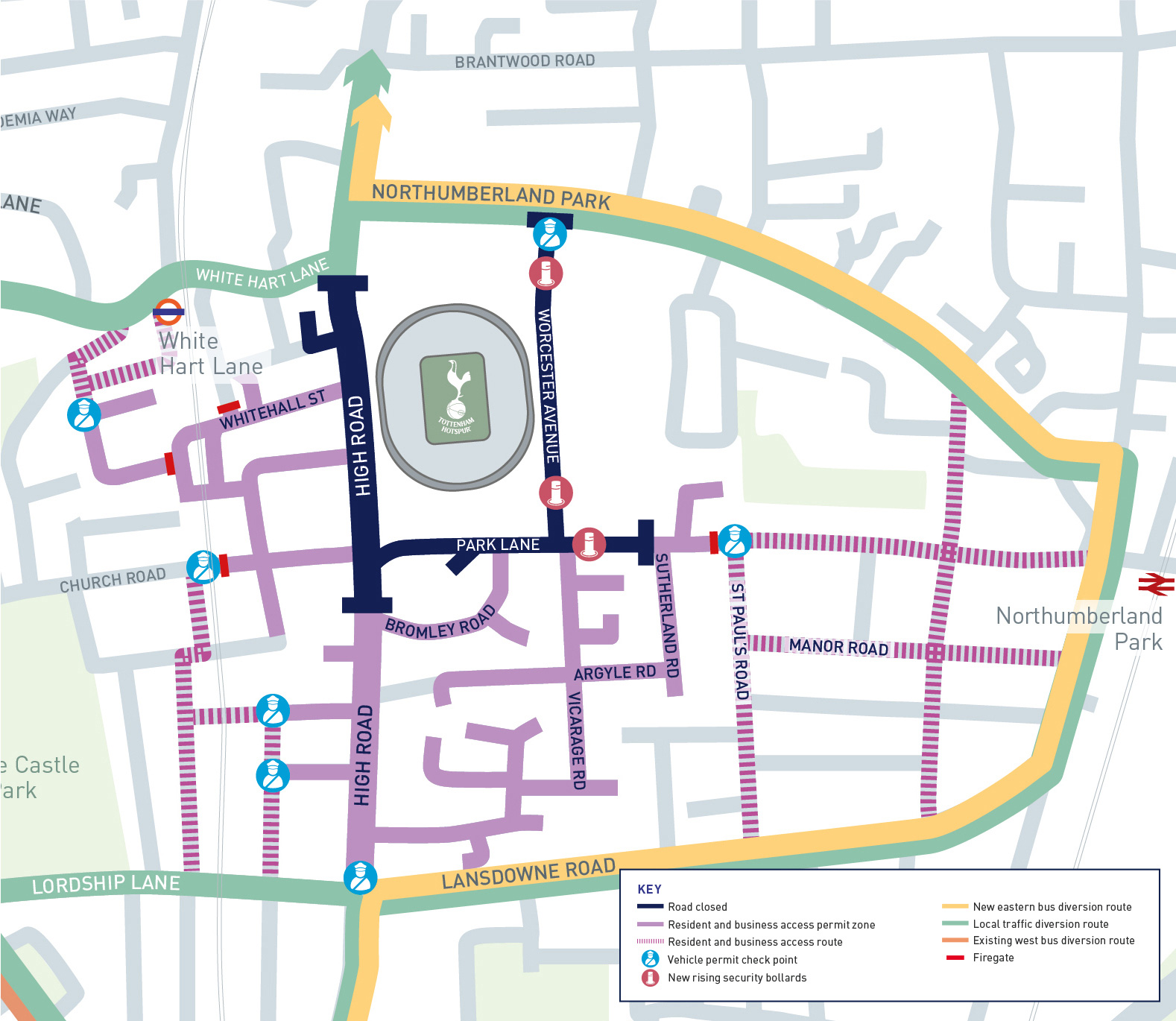
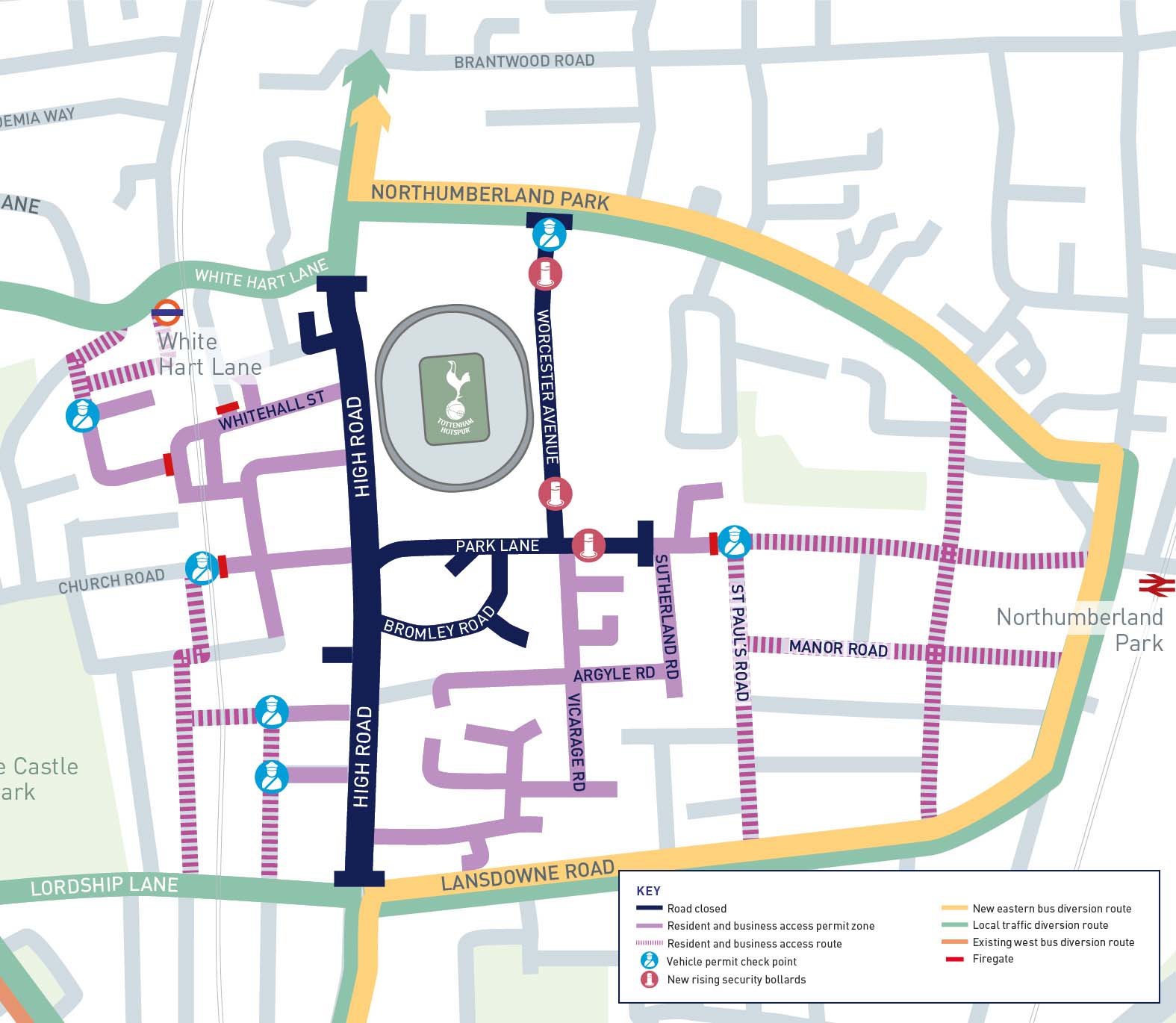
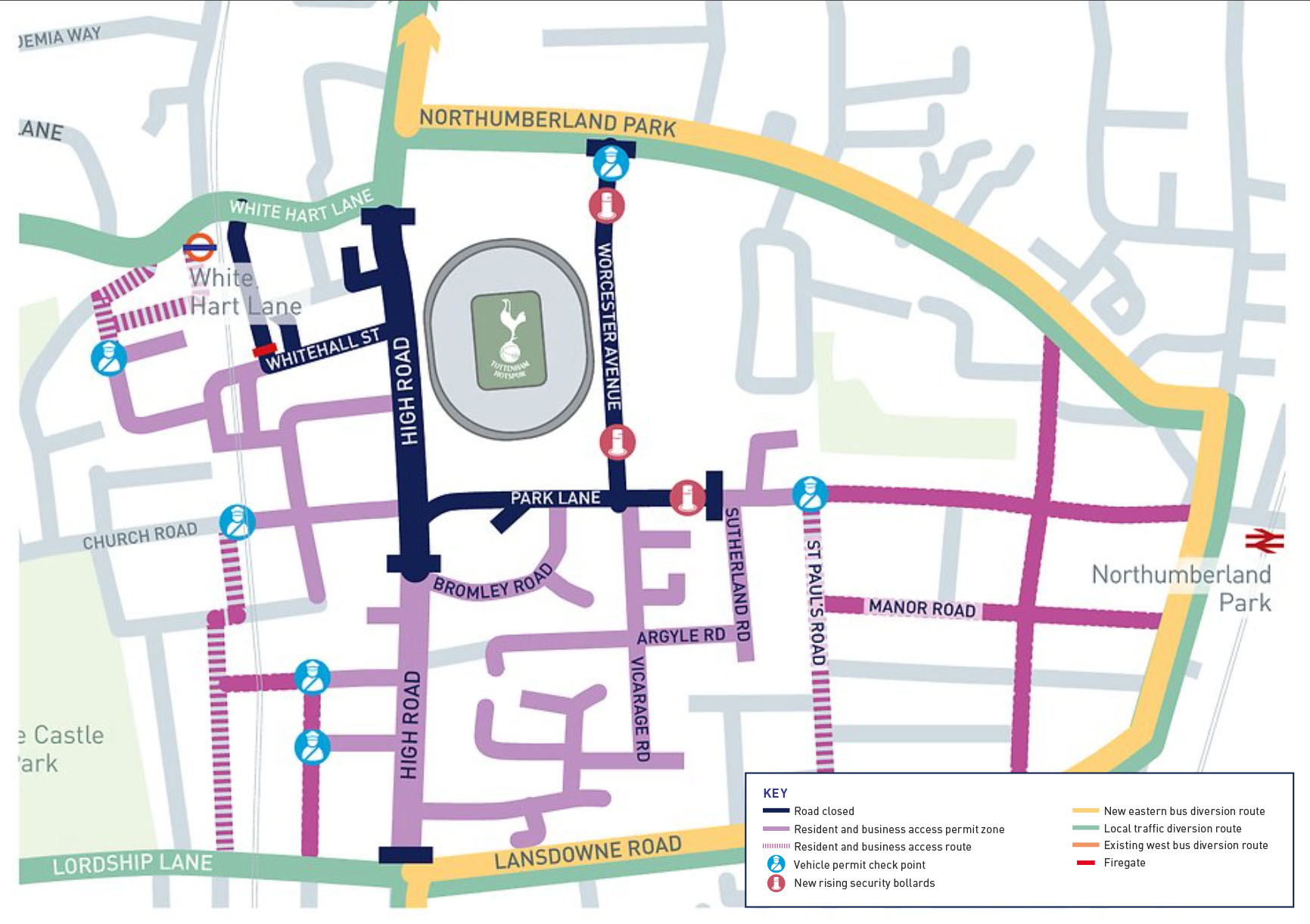
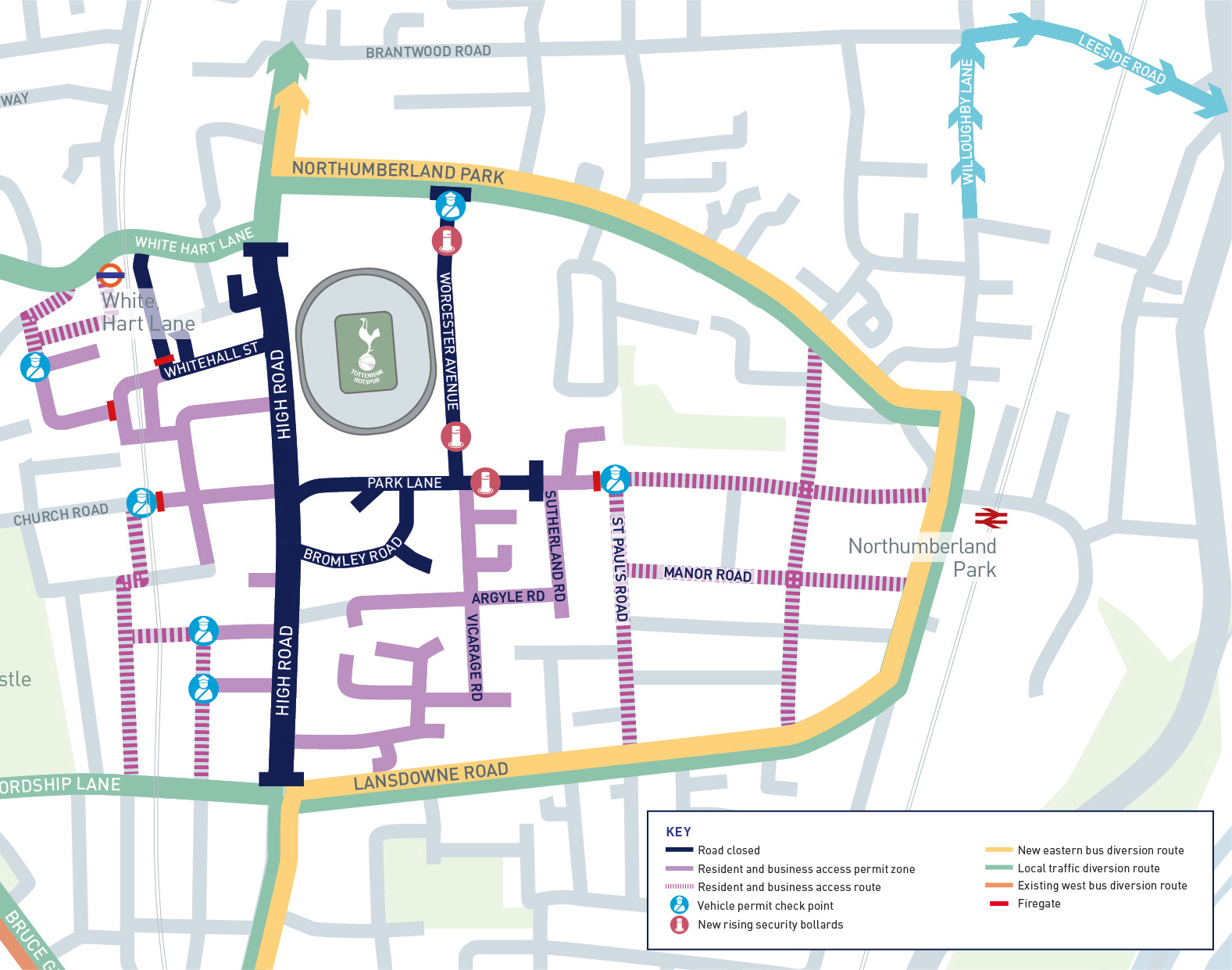
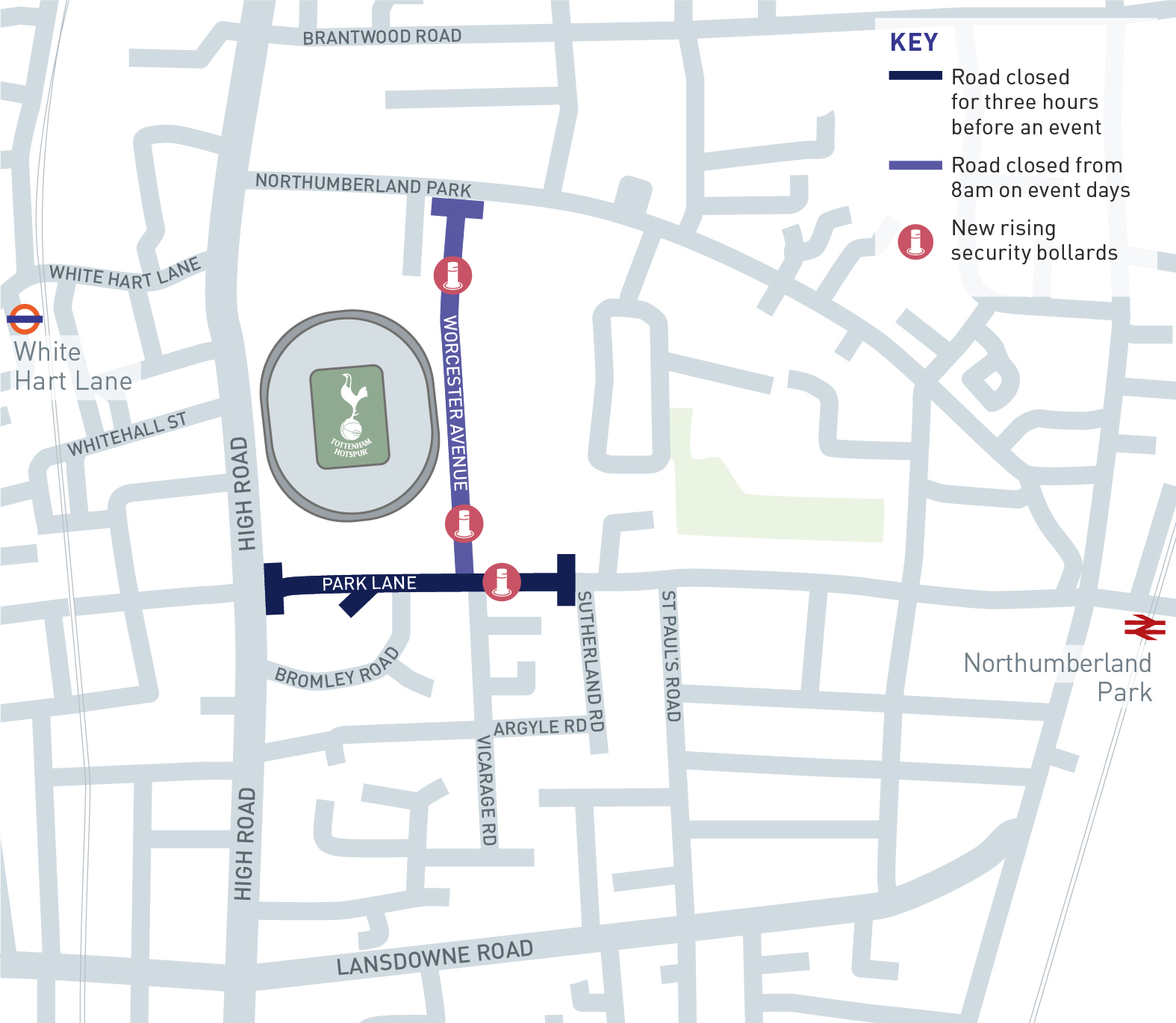
Please note that some roads closest to the stadium will be closed before, during and immediately after the match to make it safe for spectators, local residents and businesses and to ensure emergency services can access the area. A number of side roads around the stadium are closed to general traffic access, from two hours before, during and up to one hour post-match. No vehicles other than emergency services and local residents/businesses or vehicles with the necessary permits are allowed to access the road closure zone.
Shuttle Bus, Coach Services & TfL Buses
The Stadium is well served by a comprehensive network of Shuttle Buses, dedicated Coach Services and frequent TfL Bus routes, ensuring easy and convenient access for supporters on a matchday.
What Shuttle Bus services are available?
The Stadium currently provides a free pre-booked shuttle bus service, which is accessible and available for all supporters. This service provides a high capacity, high frequency service between the stadium and Alexandra Palace (Great Northern Services) and Wood Green (Piccadilly Line) stations.
The Alexandra Palace and Wood Green shuttle services operate three hours before and two hours after the match. However, you are not advised to catch any service less than 50 minutes before kick-off to allow for the travel time and security checks at the stadium.
Although the service is free for all fans attending a match, you will need to register via the link below before booking and present your e-ticket to bus staff before entry onto a shuttle service.
What are the Shuttle Bus Pick up/Drop off locations?
Alexandra Palace Station (Great Northern Services)
Before a match, shuttle buses pick-up from Station Road (opposite the station entrance) and drop-off outside Haringey Sixth Form College – a five-minute walk from the stadium. This journey is then reversed after a match.
Wood Green Station (Piccadilly Line Services)
Before a match, shuttle buses pick-up on the High Road (opposite the bus garage) from the existing rail replacement stop just 60m from the station and also drop-off at White Hart Lane, outside Haringey Sixth Form College. After the match, the buses will drop fans outside the Green Rooms Hotel opposite Wood Green Station.
Shuttle bus services may not operate if Alexandra Palace and Wood Green stations are not open. Please check the booking website before beginning your journey.
Please note that the Premium Shuttle service from Tottenham Hale is no longer operational on matchdays.
How do I book Regional Coach Services?
Our Regional Coach Services - in association with Big Green Coach, our Official Transport Supplier - help fans get to and from our stadium on a matchday. Our coach services run from a range of towns in supporter heartlands - see locations below.
Return coach tickets start from £17 with child discounts available.
Coach travel season tickets for all home Premier League matches start at £289.
Big Green Coach also operate away travel for all non-London matches.
All coaches are timed to arrive at our coach park two hours prior to kick-off and depart 45 minutes after full time (or as soon as they are full).
What are the Coach Service Locations?
Our regular matchday coach services will run from the following locations (subject to change);
- Aylesbury
- Basildon
- Beaconsfield
- Bedford
- Birchanger Green
- Braintree
- Brentwood
- Chelmsford
- Colchester
- Dartford
- Gerrards Cross
- Gillingham
- Hemel Hempstead
- Hitchin
- Maidenhead
- Maidstone
- Milton Keynes
- Pitsea
- Rayleigh
- Shefford
- Southend on Sea
- St Albans
- Westcliff on Sea
- Wycombe
Coaches drop off and pick up in Booker Cash and Carry (Coach Park F)
Unit 39 Queen St, London N17 8HZ
Where are the Coach drop-off points in Tottenham?
The role of Arthur Rowe at our great club can never be underestimated.
Spurs through and through, born in Tottenham in 1906, Rowe achieved the dream of both playing and managing his boyhood team. He made 201 appearances for us in all competitions between 1929-1939, then, as manager, led us to our first Division One title in 1950/51 - 75 years ago today - a season after his team stormed back into the top flight via the Division Two title in 1949/50.
But it was more than that.
If we're a club known for an attacking, free-flowing style of football, then much of that philosophy stems from Arthur Rowe - and his time in Hungary.
After retiring as a player in 1939, Arthur was invited to Hungary via a friendship with Hungarian sports journalist, Laszlo 'Lotzi' Feleki to work with high school and college students in Budapest. Feleki was Arthur's translator during that period before he returned to England on the outbreak of the Second World War.
Hungarian coaches would come and watch Arthur's sessions in Hungary, as did key players, including all-time great Ferenc Puskas, as Hungary became the best team in Europe in the 1950s. Indeed, the football that took us to back-to-back titles was seen in full effect on the world stage three years later when the Marvellous Magyars memorably beat England 6-3 at Wembley and then 7-1 in Budapest in 1954. These were, according to the BBC, 'matches that started a revolution' in English football.
As we marked 75 years since our first top flight title, we take a look at the man who led us to it, including his time in Hungary with a special excerpt from our Tottenham Hotspur Opus book of 2007, explaining that Hungarian influence and the birth of 'push and run'...
Arthur pictured before a match against Wolves in 1933
Arthur, Spurs manager, pictured in 1953/54
New world
From the Tottenham Hotspur Opus
The post-War years...
Arthur Rowe arrived as manager at White Hart Lane at the end of the 1948/1949 season, having impressed the club’s directors with his forward-thinking ideas at non-League Chelmsford City. Certainly he came with an impressive CV. He was born just around the corner from White Hart Lane. He had also played for Spurs and even as a player he was known to analyse games and study tactics. It was clear he held ambitions for a coaching role once his playing career was over.
The real making of Rowe, however, was his move to Hungary before the outbreak of war. It was there that he studied a very different style of football from the one played out in England. Teams such as Arsenal in the 1930s, and Newcastle and Wolves in the 1950s, would thrive on playing long passes out of their own half to flying wingers and barnstorming centre-forwards, often bypassing the midfield.
Rowe’s philosophy was to employ the traditional passing style Spurs had used when he was a defender at the club, and reminiscent of the swift and accurate football he witnessed in Hungary. “Our style was basically the method of Spurs football taught down the years,” he said. “But with variations. Tottenham had always tried to play football to entertain. When you can get both – entertainment and effectiveness – you are on the right road.”
His philosophy became known as push-and-run. “You often see something like our style happening in a match,” he said. “A side suddenly stringing together short, quick passes and players moving intelligently to give and take them … I took our style back to the streets, the way we played it as kids – off the kerb, off the wall, taking the ball at different angles, enlisting the kerb as a team-mate who let you have the ball back immediately after you had played it quickly … the quicker the better.”
It was to transform not only the fortunes of Tottenham Hotspur, but the English game on a wider level. Rowe’s influence was immense – he was the manager who inspired both Bill Nicholson and World Cup-winning manager Alf Ramsey. To do this, though, Rowe relied on the personnel already at his disposal. Nicholson was a long-standing member of the talented team he had inherited while Ramsey had just been signed from Southampton. Together they quickly forged an understanding.
But there were plenty of very good players at the club when Rowe arrived. Ted Ditchburn was on his way to a record unbroken sequence of appearances, and considered one of the best goalkeepers in the country. Big defender Harry Clarke was signed from Lovell’s Athletic in Newport, south Wales, although he was a Londoner, and left-back Charlie Withers was another local lad. The half-backs Nicholson and Burgess proved an effective force (with Nicholson operating in front of Ramsey), and the forward line bristled with talent: Les Medley on the left wing, Sonny Walters on the right, Duquemin in the middle and inside-forwards Eddie Baily and Les Bennett.
Baily maintains that Rowe did not have to introduce any revolutionary tactics into the team. They were talented players who all liked quick passing and movement, and were good ball players.
“Contrary to rumour, he never really coached us or showed us what to do,” Baily says. “He thought there was no need, so we did a lot of it ourselves and there was a lot of natural telepathy between the players. We simply never allowed the ball to stop. There were changing room sayings like, ‘A rolling ball gathers no moss’, and ‘Make it simple, make it quick’. Those things knitted us together as a team and had us all thinking the same way.”
With Rowe encouraging his team to play their natural game, Spurs took the Second Division by storm in 1950. Leon Ruskin was a schoolboy supporter at the time. He recalls the buzz created by Rowe’s side: “The arrival of Arthur Rowe was extremely well received,” he says. “One could see immediately that Rowe knew what he was doing, and the football we were seeing was what the fans wanted.
“They had some outstanding players who formed the nucleus of the side. But before Rowe arrived, many matches were drawn, which was very frustrating. Then we started to see matches ending in a result, and the football was attractive, with man-to-man passing. The ball never travelled more than 15 yards because Rowe firmly believed in the importance of keeping possession. You passed the ball and ran into a space to receive a pass back, and the ball was pinging around all over the field. The spirits were certainly up.
“I was young, but my recollection was Rowe making it clear what his philosophy was. It had a big psychological effect on all the other sides because nobody really knew how to contend with it. They were chasing shadows a lot of the time. It took about two or three years for teams to get to grips with it.”
The stylish manner in which the side set about their promotion push was in evidence right from the outset. Spurs kicked off their campaign with impressive back-to-back 4-1 victories over Brentford and Plymouth Argyle. Meanwhile, the slip-ups, when they came, were nevertheless entertaining encounters. The rare defeats, such as the 3-2 loss against Blackburn at White Hart Lane, were dappled with exciting football.
The team were to learn from that defeat, too. They did not experience another in the league until January, an incredible run which was to lay the foundations for their eventual promotion. Spurs won 2-0 at Plymouth on August 31 before embarking on a sequence of 22 league matches unbeaten, a run which was to end with a 3-0 defeat at the hands of Leeds United on January 14, 1950.
From early September onwards, promotion, and promotion as champions no less, never seemed in doubt. Spurs were not removed from the top of the table for nine months. Their nearest rivals finished nine points adrift. The statistics also highlight the Spurs claim to league superiority: they scored 81 goals – more than any other team – and conceded just 35, which was less than any other.
The key to success, Rowe said, lay in his team rather than the tactics. “They were not just good players,” he said. “I took some marvellous players. Eddie Baily: a natural one-touch player. I never saw a man who could play a moving ball either way and with either foot as quickly and as accurately. Then there was the skipper, Ronnie Burgess – brilliant, a great player. And I don’t use that word easily. I wanted the ball moved at speed from the midfield and that is what this priceless pair did for me.
“Then there was Alf Ramsey, who gave us momentum from the back. There was no finer competitor than Ted Ditchburn in goal, nor did I think there was a better goalkeeper to be found. They played as you wanted them all to play. They were the ones who used their abilities to the full.”
But it was not just the league performances that so impressed during Rowe’s trailblazing campaign. Spurs had faced First Division opposition during The FA Cup and at no stage had they look outclassed.
After defeating Stoke City in the third round, Spurs thrashed a Sunderland side which was to finish as the third-best team in the country. Goals from Les Medley and two apiece for Sonny Walters and Bennett in a stunning 5-1 victory made it one of the most memorable days of the campaign in front of more than 66,000 fans.
Even when the cup run was ended in the fifth round by a strong Everton side at Goodison Park, it was only through a hotly-disputed penalty. The best teams in the land were well aware of what was coming the following season.
As were the fans. Rowe’s swashbuckling football soon had the crowds flocking to White Hart Lane. Those who had grown disillusioned with season after season in the second tier found much to cheer. So much so, that Tottenham Hotspur’s average attendance for the 1949/1950 season was an impressive 54,405 – the highest in the Football League. North London rivals Arsenal could only come close with an average of 51,381. Spurs’s biggest gate of the season was 70,305 for a match with Southampton on February 25. More than a million spectators visited the ground during this momentous campaign.
“Arsenal won the cup in 1950, but they were very much the secondary side in London,” Ruskin says. “Spurs were able to look down their noses at them for the first time in decades. There was tremendous excitement during that season and the press were getting very excited as well. The feeling was that Spurs just couldn’t be beaten.
“Fans back then were all working class people who stood on the terraces. There were no executive boxes. Soccer was the sport of the people. We used to stand with opposing fans and they would be just as excited by what they saw from Spurs as we were. Their team might have been thrashed, but they appreciated good football. It made you proud to hear them say, ‘What a team you’ve got!’”
Arthur talks to the players at the Lane
First Division glory
No-one could predict quite what would happen once Spurs returned to the First Division, but there was huge excitement and anticipation around White Hart Lane.
Eddie Baily remembers: “We felt that we couldn’t get the next season started quickly enough. Remember, none of us had sampled the First Division before. We didn’t fear it, we knew we were a very good side now. But we were impatient to find out just how good.”
Perhaps the most prescient view came from Stan Seymour, one of Newcastle’s directors, who had watched Spurs demolish Leicester City at Filbert Street the previous season. He told club officials: “I have never seen anything like it. If you keep that up you’ll win the First Division Championship, let alone the Second Division.”
But Spurs’ glorious charge did not start with a bang. In fact, quite the opposite. Blackpool, with Stanley Matthews in tow, travelled to White Hart Lane for the opening day of the season and ran out 4-1 winners. Still, Spurs supporters were not too downhearted. They had seen enough to suggest the team could more than hold their own in the top flight. Ken Hamilton, a young supporter, said: “I recall the first game back in the First Division, losing to Blackpool. Stanley Matthews played such a great game it was hard not to enjoy it.”
A return to winning ways was not far off. Bolton Wanderers were beaten twice in a week (with Spurs scoring four times on each occasion) and a home victory over Manchester United was soon followed by the 3-2 defeat of Aston Villa, the first of eight straight league wins, culminating in the astonishing 7-0 thrashing of Newcastle United.
If there was one game that really confirmed the club’s First Division title credentials it was this one at White Hart Lane on Saturday, November 18, 1950. In the month prior to Newcastle‘s arrival, Arthur Rowe’s attack-minded side had slammed five goals past Portsmouth and six past Stoke City, both at White Hart Lane. Much of this attacking prowess was down to the near-telepathic understanding between Walters, Baily, Medley, Bennett and Duquemin. All five were to shine against a normally solid Newcastle defence, which included highly rated Scottish international Bill Brennan.
Baily recalls: “Our form was good going into the game because we had beaten a lot of leading teams. But Newcastle had some big names, like Jackie Milburn, in the side and we were expecting a difficult game.”
A crowd of more than 70,000 spectators witnessed the match, with thousands more being turned away from the stadium. The clamour to watch what was being described as the most entertaining team in the country was gathering pace.
Those who were in attendance that November afternoon were not to leave White Hart Lane disappointed either. The home side hit seven goals past their opponents in what seemed like wave after wave of attacking brilliance. These attacks were made more impressive by the state of the pitch, which was in terrible condition.
“Most pitches we used to play on were poor because they were often based on scrub or marsh land,” says Baily. “With the big heavy boots we used to wear and heavy footballs we used to play with, it was very different from nowadays. But back then, we had nothing to compare it to, so we just got on with it.
“It certainly influenced the way we played. If passes were being held up in the mud, players would have to run back to retrieve the ball. So the key to the way we played was having players who could hit the ball clean over the surface.”
The scoring was opened after just five minutes when Les Bennett headed home following an exquisite move involving Baily, Medley and Duquemin, which left the visiting defence startled. It proved to be a sign of things to come.
Baily, off the back of a fine performance for England against Wales, soon made it 2-0, using his close control to skip past defender Joe Harvey. When Medley made the score 3-0 on 31 minutes, the floodgates seemed ajar. They flew open with Medley’s second – and his side’s fourth – just after half-time. Then the prolific Walters rifled home from long range not long after the hour mark.
“We swept them aside from the start – just steamrollered them,” says Baily. “As the goals started going in, our confidence just kept rising. Everything we tried seemed to come off. We started doing some outrageous things and they were coming off. The Newcastle players were shell-shocked in the end.”
Indeed, Newcastle had little response. With the score at 5-0, the game was as good as over. Spurs had been breath taking, but something was missing from the afternoon – a strike from the prolific Duquemin.
Having had a hand in nearly every goal, the Channel Islander would have counted himself unlucky not to have made the scoresheet. Journalist Tony Horstead later wrote: “It is almost invidious to single out a Spurs man for particular praise, but I feel that centre-forward Len Duquemin, the only man in the attack not to score, deserves the honour.”
After Medley completed his hat-trick with Spurs’s sixth 12 minutes from time, Duquemin provided his ultimate contribution, forcing the back-tracking Newcastle defender Bobby Cowell to slip under pressure and handle the ball in the penalty area. Alf Ramsey stepped up to complete the rout.
Newspaper reports the following day were full of praise. Writers who had witnessed Spurs’s progress through a division they had only just re-joined were unanimous in their praise. Horstead wrote: “The result was a soccer feast. On this showing I see no reason why Spurs, no longer the team of the year, but rather the team of the century, should not win all the honours and finish up by representing England en bloc.”
What made such a resounding performance even more poignant was that Spurs had achieved such a feat without the aid of the inspirational Burgess. He was injured for this game, though it mattered little. He was deputised by the young Colin Brittan, who hardly placed a foot wrong at left-half.
“Colin was a nice lad and a good, run-of-the-mill player,” says Baily. “He might have had a decent career at another club, and he could have played the game of his life against Newcastle - but he would never
have replaced Ronnie.”
Although Spurs lost their next game, 3-2 at Huddersfield Town, it was quickly followed by another seven-game unbeaten run as 1950 drew to a close. Huddersfield also put Spurs out of The FA Cup in the third round in early January 1951, but at least that left Rowe’s men to concentrate on the league. Eight wins in the next 12 games put Spurs in the driving seat, as they suffered only two League defeats between mid-January and the end of the season, to Burnley and Huddersfield.
The title was finally clinched on April 28, 1951, with a narrow 1-0 victory over Sheffield Wednesday at White Hart Lane. Duquemin scored the goal, richly deserved for a player who rarely got his full share of credit.
For the first time in their history, Tottenham Hotspur were Division One champions...
Words | Gerry Cox
Our 1950/51 title-winning squad - with Arthur back row, far left
Can I get to the Stadium via TfL Buses?
The Stadium is well-served by TfL buses, albeit with some services diverted during the road closure period. Bus diversions will be minimised, so they are back operating on the High Road as soon as possible after the final whistle.
Before and during a match, services that normally run up and down the High Road (149, 259, 279 and 349) are diverted to the east of the stadium at Lansdowne Road, rejoining the High Road at the Northumberland Park junction.
Accessible Parking & Transport
Accessible parking at the Tottenham Hotspur Stadium is available for eligible supporters registered with the club’s Disability Access Scheme and holding a Blue Badge, with spaces needing to be booked in advance and arriving early recommended due to matchday restrictions. Additional parking options nearby are limited, so driving is generally discouraged. The stadium is well connected by accessible public transport, including step-free train stations, bus routes, shuttle services, and taxi drop-off points, all supported by clear signage and routes to help make your journey as smooth as possible.
Other Modes of Transport
Are you an avid cyclist? Thinking about getting a taxi or driving your car? Find out more ways to get to Tottenham Hotspur Stadium on a matchday.
Can I cycle to the Stadium on a matchday?
Cycling to the Stadium
We encourage spectators to cycle to Tottenham Hotspur Stadium. There is ample cycle parking around the stadium and at the Tottenham Community Sports Centre and St Francis De Sales School, with capacity for 220 bicycles across the two sites.
Cycle Superhighway 1 begins on Church Road immediately opposite the stadium and runs to Liverpool Street station.
There is both on-street and off-street cycle parking provided in the local area around the stadium.
Please see the cycle map for the locations.
Cycling equipment such as puncture kits and removable seats will be allowed into the stadium. Helmets (but not those with a full mask attached) will also be permitted.
Can I get dropped off by a Taxi or Private Hire?
Taxis
Matchday road closures prevent spectators from being dropped-off or picked-up close to the Stadium. If you need to use a taxi or private hire vehicle, we recommend you are dropped-off and / or picked-up at least a 15 minute walk (0.5m) away from the Stadium.
What if I decide to drive my car?
No Parking Available
There is no parking available for general admission fans at the Stadium.
The road closures also mean that, if you choose to travel by car, you will not be able to exit any car parking facility within the road closure area for one hour after the final whistle.
Therefore, in most cases, we discourage fans from driving to the Stadium, so please explore your public transport options before travelling.
Is there Accessible Car Parking?
Accessible Parking
Parking for supporters with a disability is available in and around the stadium, subject to availability. If you have accessibility requirements and are not registered with our Disability Access Scheme, please email access@tottenhamhotspur.com.
However, please note that the car parking spaces for disabled fans are within the road closure zone, so you will need to arrive early to access these and stay longer before departing.